3. Limites à l'infini
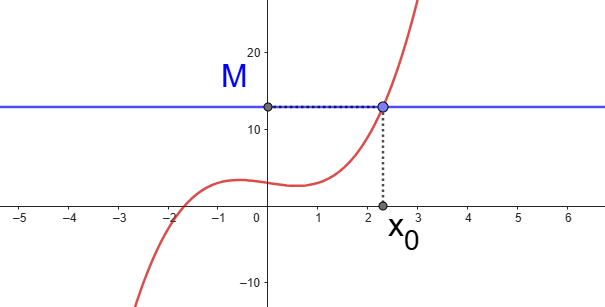
Définition : limite \(+\infty\) en \(+\infty\)
-
Soit \(f\) une fonction définie sur un intervalle \([A, +\infty[\).
On dit que :
\[
\lim_{x \to +\infty} f(x) = +\infty
\]
si et seulement si :
\(\forall M > 0,\ \exists x_0 \in \mathbb{R}\) tel que\( \forall x \ge x_0,\ f(x) > M\).
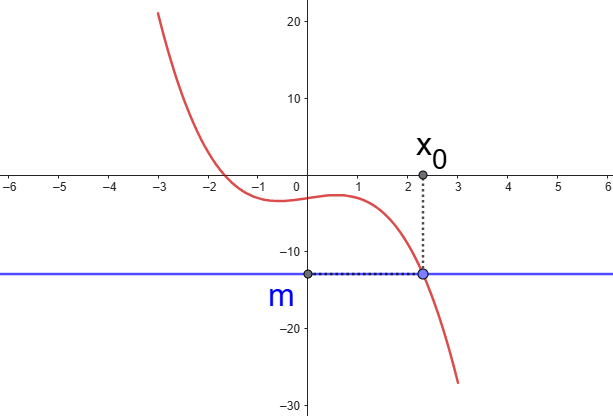
Définition : limite \(-\infty\) en \(+\infty\)
-
Soit \(f\) une fonction définie sur un intervalle \([A, +\infty[\).
On dit que :
\[
\lim_{x \to +\infty} f(x) = -\infty
\]
si et seulement si :
\(\forall m < 0,\ \exists x_0 \in \mathbb{R}\) tel que\( \forall x \ge x_0,\ f(x) < m\).
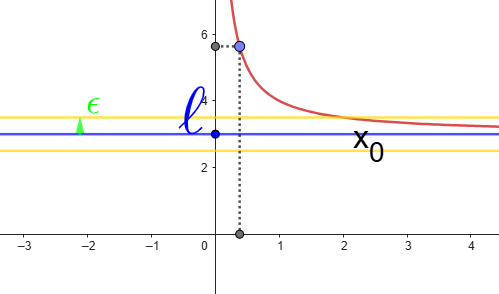
Définition : limite finie en \(+\infty\)
-
Soit \(f\) une fonction définie sur un intervalle \([A, +\infty[\).
On dit que :
\[
\lim_{x \to +\infty} f(x) = \ell
\]
si et seulement si :
\(\forall \varepsilon > 0,\ \exists x_0 \in \mathbb{R}\ \) tel que\(
\forall x \ge x_0,\ |f(x) - \ell| < \varepsilon\).
Dans ce cas, on dit que la droite \(y=\ell\) est une
asymptote horizontale à \(C_f\) .
On définit de même les limites en \(-\infty\)
-
Soit \(f\) une fonction définie sur un intervalle \(] -\infty;A]\).
- On dit que :
\[
\lim_{x \to -\infty} f(x) = +\infty
\]
si et seulement si :
\(\forall M> 0,\ \exists x_0 \in \mathbb{R}\ \) tel que\(
\forall x \le x_0,\ f(x)\ge M\).
-
On dit que :
\[
\lim_{x \to -\infty} f(x) = -\infty
\]
si et seulement si :
\(\forall m< 0,\ \exists x_0 \in \mathbb{R}\ \) tel que\(
\forall x \le x_0,\ f(x)\le m\).
- On dit que :
\[
\lim_{x \to -\infty} f(x) = \ell
\]
si et seulement si :
\(\forall \varepsilon > 0,\ \exists x_0 \in \mathbb{R}\ \) tel que\(
\forall x \le x_0,\ |f(x) - \ell| < \varepsilon\).
Dans ce cas, on dit que la droite \(y=\ell\) est une
asymptote horizontale à \(C_f\) .
1.3 Limite à l'infini des fonctions usuelles
| Fonction \(f(x)\) | Limite en \(+\infty\) | Limite en \(-\infty\) |
|---|
| \(k\) (constante) | \(k\) | \(k\) |
| \(x\) | \(+\infty\)\(\) | \(-\infty\) |
| \(x^n\) | \(+\infty\) | \(+\infty\) si n pair
\(-\infty\) si n impair |
| \(\mathrm{e}^x\) | \(+\infty\) | \(0\) |
| \(\mathrm{e}^{-x}\) | 0 | \(+\infty\) |
| \(\dfrac{1}{x}\) | \(0\) | \(0\) |
| \(\dfrac{1}{x^n}\) | \(0\) | \(0\) |
| \(\sqrt{x}\) | \(+\infty\) | non définie |
| \(\sin x\) | pas de limite | pas de limite |
| \(\cos x\) | pas de limite | pas de limite |
Tableaux : Opérations sur les limites
1) Somme : \(\lim(f+g)\)
| \(\lim f\) \ \ | \ \ \ \(\lim g\) |
\(+\infty\) |
\(-\infty\) |
Réel \(M\) |
| \(+\infty\) |
\(+\infty\) |
FI |
\(+\infty\) |
| \(-\infty\) |
FI |
\(-\infty\) |
\(-\infty\) |
| Réel \(L\) |
\(+\infty\) |
\(-\infty\) |
\(L+M\) |
2) Produit : \(\lim(f \cdot g)\)
| \(\lim f\) \ \ | \ \ \ \(\lim g\) |
\(+\infty\) |
\(-\infty\) |
Réel \(M>0\) |
Réel \(M<0\) |
0 |
| \(+\infty\) |
\(+\infty\) |
\(-\infty\) |
\(+\infty\) |
\(-\infty\) |
FI |
| \(-\infty\) |
\(-\infty\) |
\(+\infty\) |
\(-\infty\) |
\(+\infty\) |
FI |
| Réel \(L>0\) |
\(+\infty\) |
\(-\infty\) |
\(L\cdot M\) |
\(L\cdot M\) |
0 |
| Réel \(L<0\) |
\(-\infty\) |
\(+\infty\) |
\(L\cdot M\) |
\(L\cdot M\) |
0 |
| 0 |
FI |
FI |
0 |
0 |
0 |
3) Inverse : \(\lim\left(\dfrac{1}{f}\right)\)
| \(\lim f\) |
\(+\infty\) |
\(-\infty\) |
Réel \(M\neq 0\) |
0\(^+\) |
0\(^-\) |
| \(1/f\) |
0 |
0 |
\(\dfrac{1}{M}\) |
\(+\infty\) |
\(-\infty\) |
4) Quotient : \(\lim\left(\dfrac{f}{g}\right)\)
| \(\lim f\) \ \ | \ \ \ \(\lim g\) |
\(+\infty\) |
\(-\infty\) |
Réel \(M>0\) |
Réel \(M<0\) |
0\(^+\) |
0\(^-\) |
| \(+\infty\) |
1 |
-1 |
\(+\infty\) |
\(-\infty\) |
\(+\infty\) |
\(-\infty\) |
| \(-\infty\) |
-1 |
1 |
\(-\infty\) |
\(+\infty\) |
\(-\infty\) |
\(+\infty\) |
| Réel \(L\neq 0\) |
0 |
0 |
\(\dfrac{L}{M}\) |
\(\dfrac{L}{M}\) |
\(\pm\infty\) |
\(\mp\infty\) |
| 0 |
0 |
0 |
0 |
0 |
0 |
0 |
Remarque :
FI = Forme Indéterminée.
Retour